
June 29, 2011
Tragic Bus Accident
Early yesterday morning, 16 people died in a gruesome wreck just a few minutes from our house. They were traveling on a double-level bus and hit a large truck basically head on. The details are still sketchy, but the impact was incredible. The entire bus was sitting on the road off it's base, like you'd just scooted it right off the axles and steel plate. (Click on the picture to go to the news article. NOTE: It's written in Spanish.)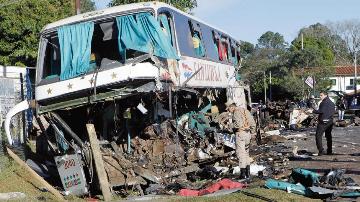
We were on the road that day, and more than once I commented over the speed that these buses travel on these less than ideal roads. They come around curves at ridiculous speeds, that would put the General Lee on two wheels in a heartbeat. They have these shock systems (or something like that) that keep them from tipping over when they turn so sharply, and I can attest that from the inside, the riders never realize that they're making crazy turns. It's a very smooth ride. But to watch them from the outside, it looks like they'll tip right over. I had no idea when we talked about how unsafe they are, that we'd come home to news stories and horrid pictures of bodies that weren't quite "bodies" any more. Just awful.
And just one week before, Saul and a visiting professor from Lee University took one of these huge buses on the same five-hour cross-country trip, passing this same spot. The two-story ones generally make longer trips and don't stop often. The normal, school-bus sized ones, are more common but just as dangerous.
We have a friend Grecia (GRAY see uh), a youth from church, who was run over by a common bus a couple of weeks ago. The "rules of the road" as these buses go, dictate that they slow down just a tad, and folks jump on or off during this time. (Any wonder Ken refuses to let me take the bus to therapy?) I think "officially" they're supposed to stop and wait, but time is money. Well, our friend was getting on, when the bus took off a bit suddenly. She lost her footing, fell down, and the bus wheel ran over her from her toes to her hips. She told me it was like slow motion, and that she waited for it to run over her trunk and then her head, while she was unable to move. She knew she was a few seconds from death and was already imagining "the other side". Someone screamed, and the driver stopped, then backed up. So she was basically run over twice, crushing the bones around her lower leg and ankle, and destroying the soft tissue of her upper leg. She said she was thanking God so much for her life, that the people around her began to get excited and do the same. Get this... the driver had a schedule to keep, so--are you ready?--he kept going. HE RAN OVER A YOUNG GIRL AND KEPT GOING!!!!
One of my fellow patients in PT has a similar story, although she wasn't knocked under the bus. She fell as she was trying to get off and the bus suddenly jerked forward. I asked if the driver stopped to see if she was okay, or if they offered to help her, but her reply was, "Oh, no. We all know how the buses are here, and it's just a chance we take." And there are soooo many people who rely on the buses as their ONLY way of transportation, so many who aren't really in physical shape to be jumping on and hurrying off again.
There have been lots of deadly accidents involving the buses lately. I heard a radio program the other day encouraging the riders to stand up to the drivers and demand that they slow down or drive more carefully, but I can't imagine this EVER happening. I've been on many buses where the driver was racing another bus, or a car, or a motorcycle, and they're always counting the change and issuing the tickets while they drive (no, not looking at the road). I can't tell you how many times I've seen them clip other vehicles (once it was ours) or run people off the road. One guy in particular, which I try to avoid, is always racing against his watch, having his assistant time him on different legs of the trip. And of course, the bus is packed with more than double its allotted maximum passengers, most of whom are standing up while he flies over speed bumps and zooms around the curves. But the consequences are few for the drivers, and they're hardly ever held responsible for the wrongs they get caught at. I wish you could have seen the driver's face when he hit our car and we were copying down his information. He knew it didn't matter one bit....
Well, that's my rant about the bus lines in PY. Please pray for the families of these killed yesterday, and for the others who were injured. And our friend Grecia would appreciate your prayers as she recovers. She's making good use of the wheelchair and walker I've "grown out of" and is happy to be alive!
...continue reading
We were on the road that day, and more than once I commented over the speed that these buses travel on these less than ideal roads. They come around curves at ridiculous speeds, that would put the General Lee on two wheels in a heartbeat. They have these shock systems (or something like that) that keep them from tipping over when they turn so sharply, and I can attest that from the inside, the riders never realize that they're making crazy turns. It's a very smooth ride. But to watch them from the outside, it looks like they'll tip right over. I had no idea when we talked about how unsafe they are, that we'd come home to news stories and horrid pictures of bodies that weren't quite "bodies" any more. Just awful.
And just one week before, Saul and a visiting professor from Lee University took one of these huge buses on the same five-hour cross-country trip, passing this same spot. The two-story ones generally make longer trips and don't stop often. The normal, school-bus sized ones, are more common but just as dangerous.
We have a friend Grecia (GRAY see uh), a youth from church, who was run over by a common bus a couple of weeks ago. The "rules of the road" as these buses go, dictate that they slow down just a tad, and folks jump on or off during this time. (Any wonder Ken refuses to let me take the bus to therapy?) I think "officially" they're supposed to stop and wait, but time is money. Well, our friend was getting on, when the bus took off a bit suddenly. She lost her footing, fell down, and the bus wheel ran over her from her toes to her hips. She told me it was like slow motion, and that she waited for it to run over her trunk and then her head, while she was unable to move. She knew she was a few seconds from death and was already imagining "the other side". Someone screamed, and the driver stopped, then backed up. So she was basically run over twice, crushing the bones around her lower leg and ankle, and destroying the soft tissue of her upper leg. She said she was thanking God so much for her life, that the people around her began to get excited and do the same. Get this... the driver had a schedule to keep, so--are you ready?--he kept going. HE RAN OVER A YOUNG GIRL AND KEPT GOING!!!!
One of my fellow patients in PT has a similar story, although she wasn't knocked under the bus. She fell as she was trying to get off and the bus suddenly jerked forward. I asked if the driver stopped to see if she was okay, or if they offered to help her, but her reply was, "Oh, no. We all know how the buses are here, and it's just a chance we take." And there are soooo many people who rely on the buses as their ONLY way of transportation, so many who aren't really in physical shape to be jumping on and hurrying off again.
There have been lots of deadly accidents involving the buses lately. I heard a radio program the other day encouraging the riders to stand up to the drivers and demand that they slow down or drive more carefully, but I can't imagine this EVER happening. I've been on many buses where the driver was racing another bus, or a car, or a motorcycle, and they're always counting the change and issuing the tickets while they drive (no, not looking at the road). I can't tell you how many times I've seen them clip other vehicles (once it was ours) or run people off the road. One guy in particular, which I try to avoid, is always racing against his watch, having his assistant time him on different legs of the trip. And of course, the bus is packed with more than double its allotted maximum passengers, most of whom are standing up while he flies over speed bumps and zooms around the curves. But the consequences are few for the drivers, and they're hardly ever held responsible for the wrongs they get caught at. I wish you could have seen the driver's face when he hit our car and we were copying down his information. He knew it didn't matter one bit....
Well, that's my rant about the bus lines in PY. Please pray for the families of these killed yesterday, and for the others who were injured. And our friend Grecia would appreciate your prayers as she recovers. She's making good use of the wheelchair and walker I've "grown out of" and is happy to be alive!


June 18, 2011
Things I See
This past week in our treks to the hospital and back, I thought about all the things that we see regularly along the way, that we’d probably not see in the U.S. Things that I may have looked twice at a few years back, but now are just common sightings.
I couldn’t quite get my cell phone out in time to take a picture of it, but we drove alongside an interesting truck. The cargo bed was filled with raw meat--what appeared to be beef ribs, not wrapped or anything, but just piled up in the back of the truck on their way (eventually) to our tables. We often pass the little old ladies who strap wooden boxes on the sides of their donkeys, kinda like saddle bags you’d see on a big motorcycle. Sometimes the ladies also ride the donkeys, but most often they are walking alongside them selling the contents of the boxes to folks they pass on the way. What’s in there? Glad you asked. The chickens they butchered that morning, including the innards and gooey parts, which always seem to string along outside the boxes.
I couldn’t get to the phone in time to snap a shot of the tigers in cages, either, but they were being pulled behind a truck with a guy who was announcing the arriving circus. Those big cats were stalking back and forth in their cages as they passed all the people waiting at bus stops, walking along the side of the road, or waiting for the light to turn red so they can wash windshields. I wonder if anyone tried to wash THOSE windshields!
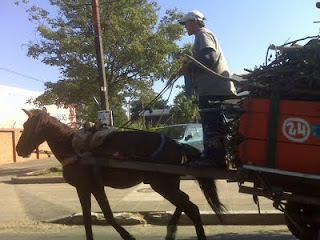 And no matter how much traffic there is on the road--even those highly congested four-lane roads that run through the middle of the business district—we’re bound to drive up on a horse cart with a driver and one or two passengers, picking up any discarded items that might be of value. Usually they find plastic, glass, and metal trash, all of which can be sold for a tiny bit of money. This one was full of small limbs and sticks, which will be used to make cooking fires. The sides of the carts are decorated with cd’s, bottle caps, or even a painted-on Nike swoosh.
 You probably already know that most life in the Latino culture revolves around the Catholic church. It’s the central location of each town’s plaza, the place where you officially become “part of the human club” by getting baptized as an infant, and then check out of the club on your way to be buried. It’s the site of weddings, graduations, and community celebrations. More than the actual building, its presence is always there, in the back of the mind of practically any native South American, as the driving force behind the traditions and customs that make the culture what it is. I still found it odd to see the Ferris wheel of the latest town fair, so close to the belltower that it looks like you could jump from one to the other. I think this picture perfectly illustrates the point that what happens here happens under the mango tree or at the Catholic church.
You pass anything interesting on your commute lately?
...continue reading
I couldn’t quite get my cell phone out in time to take a picture of it, but we drove alongside an interesting truck. The cargo bed was filled with raw meat--what appeared to be beef ribs, not wrapped or anything, but just piled up in the back of the truck on their way (eventually) to our tables. We often pass the little old ladies who strap wooden boxes on the sides of their donkeys, kinda like saddle bags you’d see on a big motorcycle. Sometimes the ladies also ride the donkeys, but most often they are walking alongside them selling the contents of the boxes to folks they pass on the way. What’s in there? Glad you asked. The chickens they butchered that morning, including the innards and gooey parts, which always seem to string along outside the boxes.
I couldn’t get to the phone in time to snap a shot of the tigers in cages, either, but they were being pulled behind a truck with a guy who was announcing the arriving circus. Those big cats were stalking back and forth in their cages as they passed all the people waiting at bus stops, walking along the side of the road, or waiting for the light to turn red so they can wash windshields. I wonder if anyone tried to wash THOSE windshields!


You pass anything interesting on your commute lately?
June 11, 2011
You Just Never Know...
…how your day’s gonna go. Wednesday, we left the house with four medical appointments planned. For some reason, traffic was much heavier and I arrived late to therapy, the first appointment. I really rushed through my exercises to make it in time to take my latest x-rays of the leg. After getting those, I ran (okay, hobbled quickly) down to the doctor’s office to find that he’d cancelled appointments due to an emergency surgery. Well, that’s understandable, I just wish I’d known that before the couple of hours of rushing around to make it there.
We had lunch and made it just in time to my dentist’s appointment, where she is replacing the crown that broke in a top molar. This is a procedure that would take an afternoon in the US, but is scheduled to take 4 visits here. Well, it WAS scheduled to take that, until, for the second appointment in a row, the little thing they put in my tooth to make the crown stay in place, broke again. We’re up to six appointments now.
It turns out that Sara needed us to run an errand while we were out, and it seemed we’d have the time now that the dentist’s appointment was abruptly ended. We plowed through traffic but only got a few miles in an hour, and arrived too late to complete the errand. What a day! Rushing here, there, and everywhere, mostly to no avail.
The next morning we got up as normal, and headed back out for physical therapy. I have to admit that I was dreading it, because the cold weather means I’m in a lot of pain before I even arrive. About halfway there, we heard a loud clunking noise and pulled over. It seems that the CV joint we’d just had replaced, led to a bolt that wasn’t quite tight enough, and the axle of our front wheel came loose. (No ugly comments if that makes no sense—that’s my female interpretation of what happened.) Thank God, we were in one of the very few places where traffic was not super-congested, and where there is a whole lane on the side of the road that’s safe to pull into.
Ken was just starting to figure out what the problem was when a man pulled over. This is typical of our experience with Paraguayans--always willing to lend a hand. The guy happened to be passing through in his work truck, and lives only a couple of blocks from where we’d broken down. He told Ken that he knew an honest, inexpensive mechanic that lived nearby. They walked to the mechanic’s house, the guy bought Ken a bag of empanadas for us, and they talked about why we’re in Paraguay all the way there and back. God’s good about arranging our days, huh? The car fix cost us about $10, I got out of therapy, and Ken made a new friend.
...continue reading
We had lunch and made it just in time to my dentist’s appointment, where she is replacing the crown that broke in a top molar. This is a procedure that would take an afternoon in the US, but is scheduled to take 4 visits here. Well, it WAS scheduled to take that, until, for the second appointment in a row, the little thing they put in my tooth to make the crown stay in place, broke again. We’re up to six appointments now.
It turns out that Sara needed us to run an errand while we were out, and it seemed we’d have the time now that the dentist’s appointment was abruptly ended. We plowed through traffic but only got a few miles in an hour, and arrived too late to complete the errand. What a day! Rushing here, there, and everywhere, mostly to no avail.
The next morning we got up as normal, and headed back out for physical therapy. I have to admit that I was dreading it, because the cold weather means I’m in a lot of pain before I even arrive. About halfway there, we heard a loud clunking noise and pulled over. It seems that the CV joint we’d just had replaced, led to a bolt that wasn’t quite tight enough, and the axle of our front wheel came loose. (No ugly comments if that makes no sense—that’s my female interpretation of what happened.) Thank God, we were in one of the very few places where traffic was not super-congested, and where there is a whole lane on the side of the road that’s safe to pull into.
Ken was just starting to figure out what the problem was when a man pulled over. This is typical of our experience with Paraguayans--always willing to lend a hand. The guy happened to be passing through in his work truck, and lives only a couple of blocks from where we’d broken down. He told Ken that he knew an honest, inexpensive mechanic that lived nearby. They walked to the mechanic’s house, the guy bought Ken a bag of empanadas for us, and they talked about why we’re in Paraguay all the way there and back. God’s good about arranging our days, huh? The car fix cost us about $10, I got out of therapy, and Ken made a new friend.
June 9, 2011
Culture Shock
This week I taught a class to the mission interns about culture shock, and I got the chance to reflect a bit on how "exciting" that can be. Okay, maybe exciting isn't the BEST word! It's quite a trying process, but one that has benefits if we let God do His work in us at whatever stage we're in.
The Bible gives us several examples of people who left their home culture to live in another, and we can look to them for wisdom. Folks like Daniel, the 3 Hebrew children, Ruth, Paul, Esther--dare I say it?--even Jesus, left what they'd known and ventured into a new world, and God was able to use that for His benefit.
Most folks agree that culture shock comes in four basic stages, as I'll talk about in a bit. It was kind of nice to think back on going through those stages at different points since our move here, and to realize how faithful God is to hold my hand through it all. It's also a bit unnerving to think about the reality of culture shock, which is that it is a never-ending process for those who choose to live outside their birth country. The stages may not always be as difficult, but we cycle through them over and over in varying degrees, because we can never unlearn the cultural values we grew up in.
The first stage is akin to the honeymoon, when all is new and cool and just the greatest thing on the planet. Then a bit of loneliness sets in and all the strange new things can be overwhelming, causing a retreat of sorts--sometimes manifesting as fear, sometimes as depression, almost always as an urge to avoid the new things and people. The third stage is rejection, when all these new ways of doing things are not just seen as different, but as WRONG. There is much frustration and judgment that the new stuff is all bad. At last comes a time to fit in with the culture and find ways to blend the old with the new, keeping your identity but being flexible enough to "roll with the punches" and enjoy this new world.
I remember different feelings and situations within each of those stages, which vary in duration for each person. Fortunately, the four of us cycled through these at different times and could try to help each other out. There are things that can be done in the middle of whichever stage to help alleviate the stress of it all, but the main thing is to remember that this is normal and can't be avoided. Those who resist tend to take longer to cycle through and sometimes never fully reach the last stage. It's fun to meet other expats and be able to have a general idea where they're "cycling" at the time.
The good thing is that each time you work through those 4 stages, God peels back another layer of self and exposes things you may not have known were inside you. Those weaknesses that have been hiding deep don't have much space left to hide when the safety nets are removed, such as extended family, friends, church services in your own language, traffic laws you're familiar with, police that can be trusted, food you recognize. Take these away and put something else in their places, and all those ugly little character traits like anger and fear and irritation come right up to the surface. So culture shock can be seen as a cleaning out process, making it a positive thing for most. Think of it as boot camp that gets you ready for war.
...continue reading
The Bible gives us several examples of people who left their home culture to live in another, and we can look to them for wisdom. Folks like Daniel, the 3 Hebrew children, Ruth, Paul, Esther--dare I say it?--even Jesus, left what they'd known and ventured into a new world, and God was able to use that for His benefit.
Most folks agree that culture shock comes in four basic stages, as I'll talk about in a bit. It was kind of nice to think back on going through those stages at different points since our move here, and to realize how faithful God is to hold my hand through it all. It's also a bit unnerving to think about the reality of culture shock, which is that it is a never-ending process for those who choose to live outside their birth country. The stages may not always be as difficult, but we cycle through them over and over in varying degrees, because we can never unlearn the cultural values we grew up in.
The first stage is akin to the honeymoon, when all is new and cool and just the greatest thing on the planet. Then a bit of loneliness sets in and all the strange new things can be overwhelming, causing a retreat of sorts--sometimes manifesting as fear, sometimes as depression, almost always as an urge to avoid the new things and people. The third stage is rejection, when all these new ways of doing things are not just seen as different, but as WRONG. There is much frustration and judgment that the new stuff is all bad. At last comes a time to fit in with the culture and find ways to blend the old with the new, keeping your identity but being flexible enough to "roll with the punches" and enjoy this new world.
I remember different feelings and situations within each of those stages, which vary in duration for each person. Fortunately, the four of us cycled through these at different times and could try to help each other out. There are things that can be done in the middle of whichever stage to help alleviate the stress of it all, but the main thing is to remember that this is normal and can't be avoided. Those who resist tend to take longer to cycle through and sometimes never fully reach the last stage. It's fun to meet other expats and be able to have a general idea where they're "cycling" at the time.
The good thing is that each time you work through those 4 stages, God peels back another layer of self and exposes things you may not have known were inside you. Those weaknesses that have been hiding deep don't have much space left to hide when the safety nets are removed, such as extended family, friends, church services in your own language, traffic laws you're familiar with, police that can be trusted, food you recognize. Take these away and put something else in their places, and all those ugly little character traits like anger and fear and irritation come right up to the surface. So culture shock can be seen as a cleaning out process, making it a positive thing for most. Think of it as boot camp that gets you ready for war.
June 8, 2011
Appointments....
It's getting quite chilly here, so we've pulled out the long sleeves just about the time we read about all the 100 degree days in the US. It's still so weird to me that we're in a different hemisphere. When does one get used to things like that?
We're still chugging along to physical therapy daily, and seeing good progress. I've moved from the Canadian crutch to a cane, and even though I'm a bit unstable with it, it feels good to use something less bulky. I feel the quadriceps coming back to life again, finally, and working hard to try to make the leg work. Coming along, coming along.
Camille, Caroline, and Saul, look for whatever excuse they can find to keep from having to tag along. Unfortunately, Ken's stuck, since no one thinks I can drive a car yet--so what if my clutch leg is the injured one? Can't a girl even TRY? So on days when the girls aren't doing schoolwork in the waiting room, they can be found here on the grounds helping out with the 3 visiting missions interns from Lee University. Camille and Caroline are loving being their official translators and helping out with VBS, English classes, and a few other projects.
Saul is a big help with taking care of business closer to home while we're making the Asuncion trip each day. He is continuing with night school, and had a great opportunity to give a Bible to one of his teachers. We had just been talking about praying for God to make the daily "meetings" He arranges obvious to us--those times when He sets up a chance for us to share His love with someone. Too often I think we humans miss those chances.
Today Saul made a trip out to a town a couple hours away, where the pastor lives who was awarded the motorcycle (Remember that story?) Saul went to work more on the process of getting the motorcycle legally registered and licensed. It's quite a taxing process in this country... always an adventure! The good news is that the pastor is doing well, having started visitation in a new area with an additional house church meeting taking place there. 7 new converts were recently baptized! It's great to know he's able to get out and minister in more places now with a dependable form of transportation.
Well, that's the latest "what's up" from our end. What's new with you?
...continue reading
We're still chugging along to physical therapy daily, and seeing good progress. I've moved from the Canadian crutch to a cane, and even though I'm a bit unstable with it, it feels good to use something less bulky. I feel the quadriceps coming back to life again, finally, and working hard to try to make the leg work. Coming along, coming along.
Camille, Caroline, and Saul, look for whatever excuse they can find to keep from having to tag along. Unfortunately, Ken's stuck, since no one thinks I can drive a car yet--so what if my clutch leg is the injured one? Can't a girl even TRY? So on days when the girls aren't doing schoolwork in the waiting room, they can be found here on the grounds helping out with the 3 visiting missions interns from Lee University. Camille and Caroline are loving being their official translators and helping out with VBS, English classes, and a few other projects.
Saul is a big help with taking care of business closer to home while we're making the Asuncion trip each day. He is continuing with night school, and had a great opportunity to give a Bible to one of his teachers. We had just been talking about praying for God to make the daily "meetings" He arranges obvious to us--those times when He sets up a chance for us to share His love with someone. Too often I think we humans miss those chances.
Today Saul made a trip out to a town a couple hours away, where the pastor lives who was awarded the motorcycle (Remember that story?) Saul went to work more on the process of getting the motorcycle legally registered and licensed. It's quite a taxing process in this country... always an adventure! The good news is that the pastor is doing well, having started visitation in a new area with an additional house church meeting taking place there. 7 new converts were recently baptized! It's great to know he's able to get out and minister in more places now with a dependable form of transportation.
Well, that's the latest "what's up" from our end. What's new with you?
Subscribe to:
Posts (Atom)